

From Reaction to Response

What Emotional Maturity Looks Like in Real Life
There’s a place many of us get stuck.
We’ve done the inner work.
We can name our thoughts.
We understand our emotions.
But when it’s time to respond—to speak, to decide, to engage—we freeze… overcorrect… or fall right back into old patterns.
That’s because awareness, while powerful, is not the finish line.
Emotional maturity doesn’t end with insight.
It moves toward responsibility.
This post is about what happens after awareness—how renewed minds, captive thoughts, and discerned emotions show up in real conversations, real conflict, and real relationships.
Awareness Is the Beginning—Not the Goal
Many thoughtful, self-aware people assume that if they understand themselves, change will naturally follow.
But that’s not always true.
You can:
- Understand your trauma
- Identify your triggers
- Name your emotions
- Explain your patterns
And still:
- Avoid hard conversations
- Use feelings to justify harmful behavior
- Stay stuck in self-protection
Awareness reveals what’s happening.
Responsibility determines what happens next.
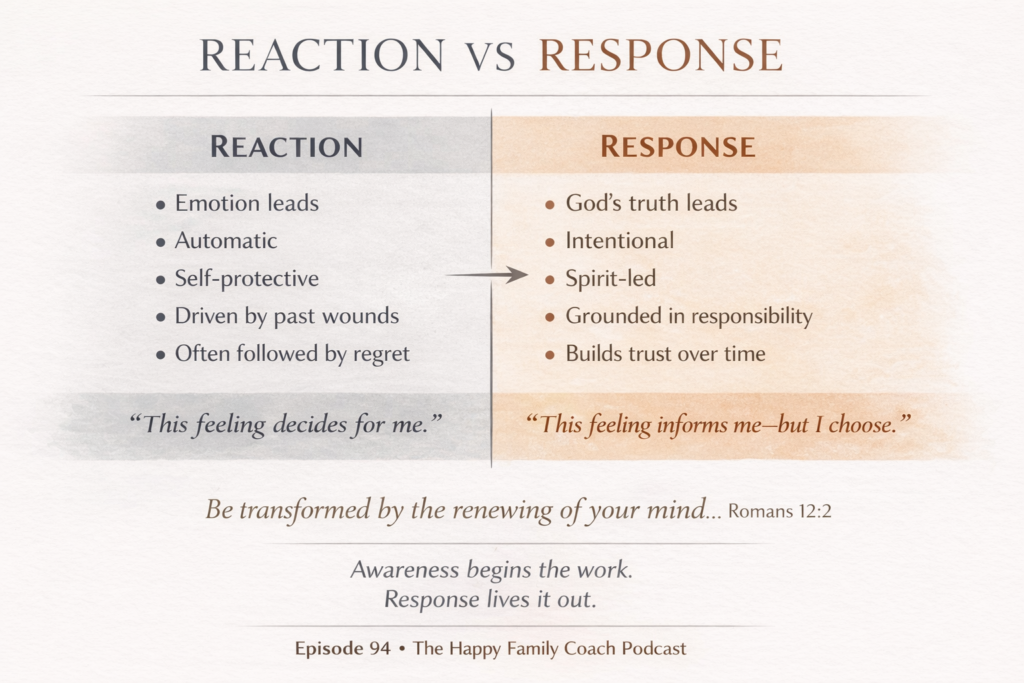
Reaction vs. Response: A Different Way to Look at It
We often think reaction and response differ by speed.
But the real difference isn’t speed.
It’s leadership.
Reaction says:
- “This feeling explains me.”
- “This emotion justifies me.”
- “This trigger decides for me.”
Response says:
- “This feeling informs me.”
- “This emotion matters—but it doesn’t lead.”
- “I still choose how I show up.”
A response is aligned—not perfect, but aligned.
With truth.
With values.
With faith.
With responsibility.
With love.
The Missing Piece: Choice
After awareness, there’s often a quiet internal moment.
And in that moment, a question appears:
“What is the wisest next step?”
Not:
- “What feels good right now?”
- “How do I protect myself?”
- “How do I control the outcome?”
But:
- “What is mine to own?”
- “What is not mine to carry?”
- “How do I respond in a way that aligns with who I’m becoming?”
Emotional maturity is revealed not in what we feel—but in the choices we make after we feel it.
What This Looks Like in Real Life
Let’s bring this out of theory and into everyday situations.
Example 1: In Marriage
Reaction:
“I feel dismissed, so I shut down or get sarcastic.”
Response:
“I’m feeling dismissed, and I want to stay connected—but I need to say this clearly instead of pulling away.”
Same feeling.
Different outcome.
Example 2: In Parenting
Your child talks back or rolls their eyes.
Reaction:
“Don’t talk to me like that!” (said sharply, fueled by embarrassment or anger)
Response:
“I’m feeling disrespected, and I need to address this—but I’m choosing to correct without shaming.”
The response still includes correction.
But it’s grounded, not reactive.
Example 3: In Conflict with a Friend
Reaction:
“I understand why I get defensive, so I don’t say anything.”
Response:
“I understand why I get defensive—and I’m still responsible for addressing this honestly.”
Understanding yourself doesn’t excuse avoidance.
It invites responsibility.
Example 4: At Work or in Leadership
Reaction:
“I’m overwhelmed, so I snap—or disappear.”
Response:
“I’m overwhelmed, and I need to clarify expectations instead of reacting from stress.”
Response creates clarity.
Reaction creates confusion.
Print and reference this chart as often as you need it:
Emotional Honesty Without Emotional Control
This is where many people get confused.
Responding does not mean:
- Suppressing emotions
- Being nice at the expense of truth
- Avoiding conflict
- Spiritualizing discomfort
A response is not passive.
A response is:
- Honest
- Boundaried
- Clear
- Grounded
You’re not trying to manage other people.
You’re learning to steward yourself.
What This Changes in Families
This is where transformation becomes visible.
When parents respond instead of react:
- Children feel safer
- Repair happens faster
- Accountability feels firm, not frightening
When spouses respond instead of react:
- Conversations stay connected
- Hard truths don’t become personal attacks
- Trust has room to rebuild
When you respond instead of react:
- Shame loosens its grip
- Agency returns
- Growth becomes sustainable
This is how renewed minds actually transform families—not through control, but through modeled wisdom.
A Gentle Invitation This Week
Not to get it right every time.
But to notice this moment:
The moment when awareness has already happened…
and choice is now in front of you.
Ask yourself:
Q: What is the most responsible response here?
Q: What aligns with who I want to be?
Q: What would love look like—without abandoning myself?
One intentional response at a time is how change takes root.
Final Encouragement
You are not behind.
You are practicing maturity.
And practice is how transformation becomes visible.
Awareness begins the work.
Response lives it out.
🎧 If you haven’t listened yet, Episode 94 of The Happy Family Coach Podcast goes deeper into this conversation and brings everything from Episodes 91–93 together. Click on player below to listen.
You don’t have to respond perfectly.
You just have to respond intentionally.
With hope and gratitude
